Aerodynamics
(known vehicles)
Theory (more)
Theory
Drag coefficient (more)
The drag coefficient (CD) can be estimated with a method presented in Handbook of Vehicle Design Analysis (p336-338), which gives a drag rating (the number under each figure) for shapes of different areas of a car body. The method adds the drag rating for only the first nine areas presented above, and the sum is put in equation (1):
|
(1) |
Based on that work, equation (1) was modified such that the base factor (0.16) could be detailed. Three other sources of drag were studied (skin friction, internal flow and the drag from all wheels (CDwheels)) such that equation (1) becomes:
|
(2) |
The skin friction and internal flow are treated like all other drag ratings. The drag coefficient (based on the frontal area of the vehicle) for EACH wheel can be estimated by:
|
(3) |
Where W is the width of the tire and D is its diameter (see TIRE SIZE for more info). The coefficient C depends on the fender and hubcap design, as follow:
| Fender type | C |
| Fender covers entirely the wheel (Full fender) | 0.0134 |
| Fender doesn't cover side, wheel has flush hubcap | 0.0225 |
| Fender doesn't cover side | 0.0267 |
| No fender, wheel has flush hubcap | 0.0924 |
| No fender (Open wheel) | 0.1100 |
Two other sources of drag can be identified, especially for race cars. The first one is for body without a closed cockpit, such as race car with open windows or open cockpit. It is treated like a drag rating as presented above.
The second one is the lift-induced drag (CDlift). When the vehicle is subjected to a lift force or a downforce, it usually doesn't come free, i.e. a drag force is created (which has to be overcome with engine power). There is no simple and direct relationship between the two forces as it really depends on how the lift force is created, but equation (4) can be used to make a crude estimate:
|
(4) |
Where CL is the lift coefficient of the vehicle, based on its frontal area.
To sum up, the drag coefficient can be found with equation (5):
|
(5) |
The modifications to go from equation (1) to equation (5) were determined mainly by examining the following data:
| Component of aerodynamic resistance coefficient | Typical value* | Minimum feasible value |
| Forebody | 0.055 | -0.015 |
| Afterbody | 0.14 | 0.07 |
| Underbody | 0.06 | 0.02 |
| Skin friction | 0.025 | 0.025 |
| Wheel and wheel wells | 0.09 | 0.07 |
| Drip-rails | 0.01 | 0.01 |
| Window recesses | 0.01 | 0.005 |
| External mirror (one) | 0.01 | 0.005 |
| Cooling system | 0.035 | 0.035 |
| Overall total drag | 0.435 | 0.195 |
| Location | ΔCD |
| Skin friction | 0.04-0.05 |
| Cooling drag | 0.00-0.06 |
| Internal flow, ventilation | 0.00-0.05 |
| Form drag (flow separations) | 0.00-0.45 |
| Lift-induced drag | 0.00-0.60 |
| Year/Make | CD | CL | |
| sedans | 1973 Opel Record | 0.47 | 0.36 |
| 1980 Peugeot 305 GL | 0.44 | 0.44 | |
| 1986 Subaru XT | 0.29-0.31 | 0.10 | |
| race cars | 1990 Mazda GTO (rear deck spoiler) | 0.51 | -0.44 |
| 1991 Mazda GTO (rear wing) | 0.48 | -0.53 | |
| 1973 Porsche 917/30 | 0.57 | -1.04 | |
| 1985 Generic Prototype | 0.74 | -1.79 | |
| Generic Porsche 962 C | 0.80 | -4.80 | |
| 1992 Mazda RX-792P | 0.70 | -3.80 | |
| 1992 Nissan P35, C | 0.50 | -3.00 | |
| 1983 generic F1, no sidepods | 1.07 | -0.99 | |
| 1987 March INDY | 1.06 | -1.71 | |
| 1991 Penske PC20, high downforce | 1.11 | -3.33 | |
| 1991 Penske PC20, speedway | 0.740 | -2.073 | |
| 1992 Galmer G92, high downforce | 1.397 | -3.688 | |
| 1992 Galmer G92, speedway | 0.669 | -1.953 |
| Location | ΔCL |
| Vehicle body | 0.35-(-0.10) |
| Wings | 0.00-(-2.00) |
| Wing/body interaction | 0.00-(-2.00) |
| Width/Diameter | CD |
| 0.28 | 0.180 |
| 0.50 | 0.40 |
| 0.612 | 0.48 |
| 0.658 | 0.32 |
| ΔCD | |||
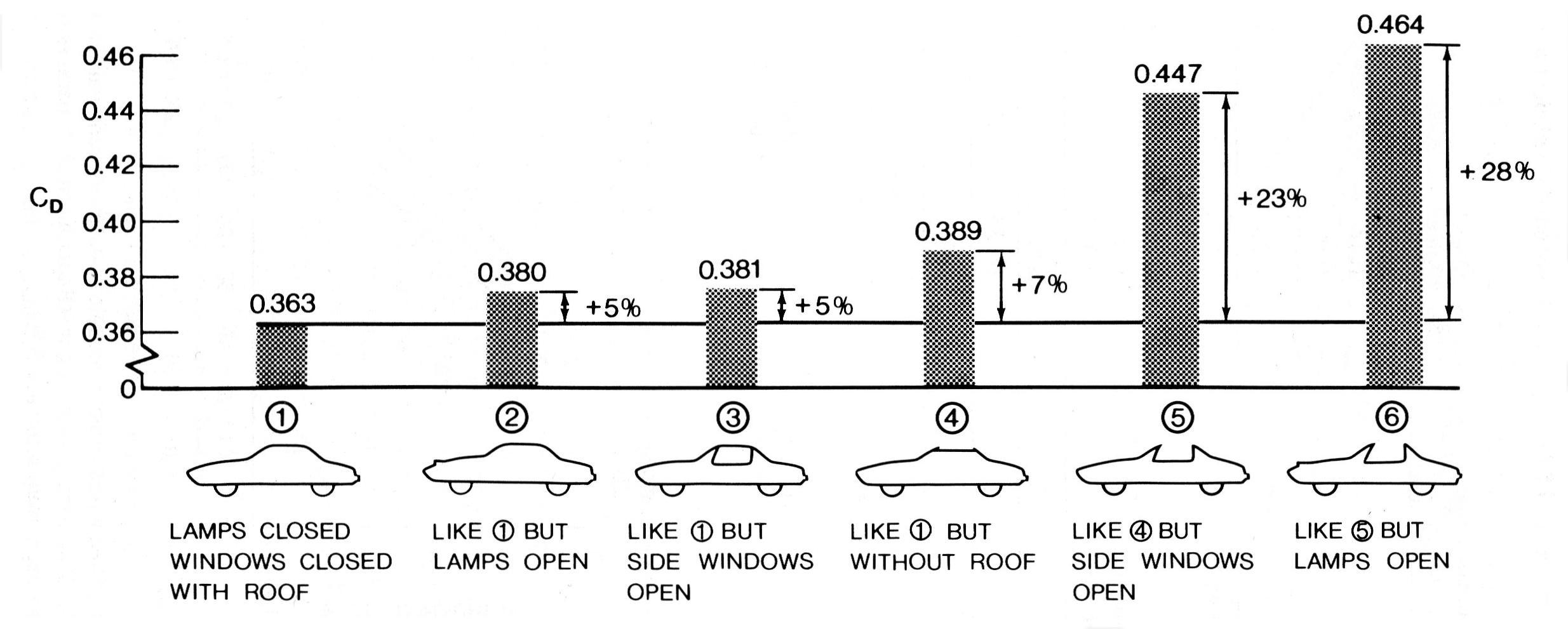
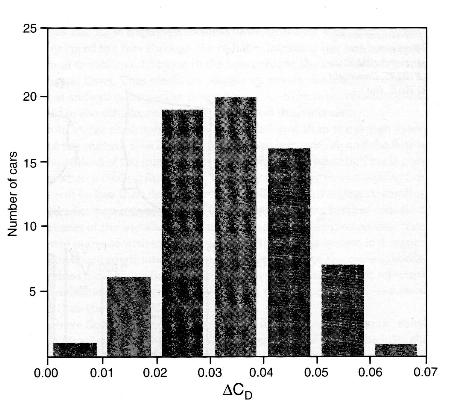
| Effect of open window | sedan | 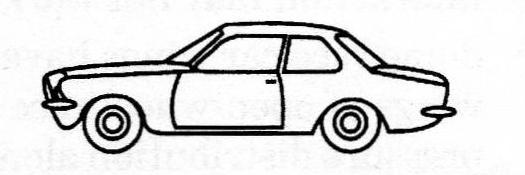 | 0.067 |
| group B race car | 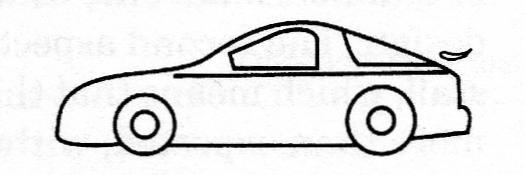 | 0.025 | |
| Effect of top | convertible sports car | 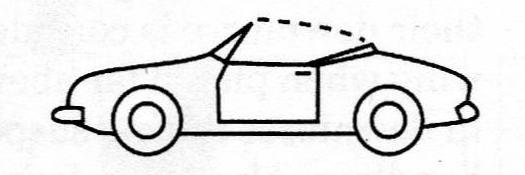 | 0.09 |
| group C race car | 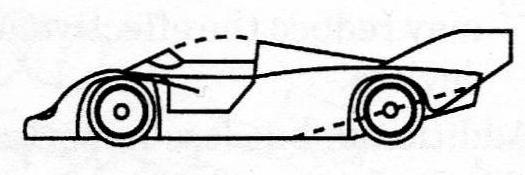 | 0.05 | |
| CL | CD | ||
| Low drag vehicle near the ground | 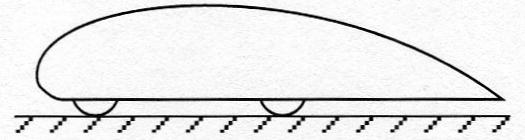 | 0.18 | 0.15 |
| Generic automobile | 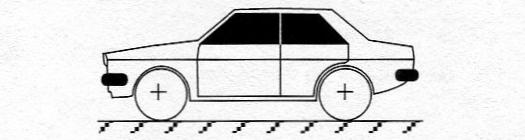 | 0.32 | 0.43 |
| Prototype race car | 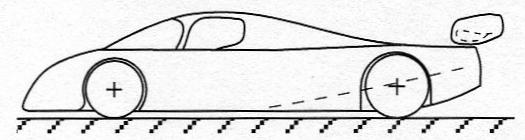 | -3.00 | 0.75 |
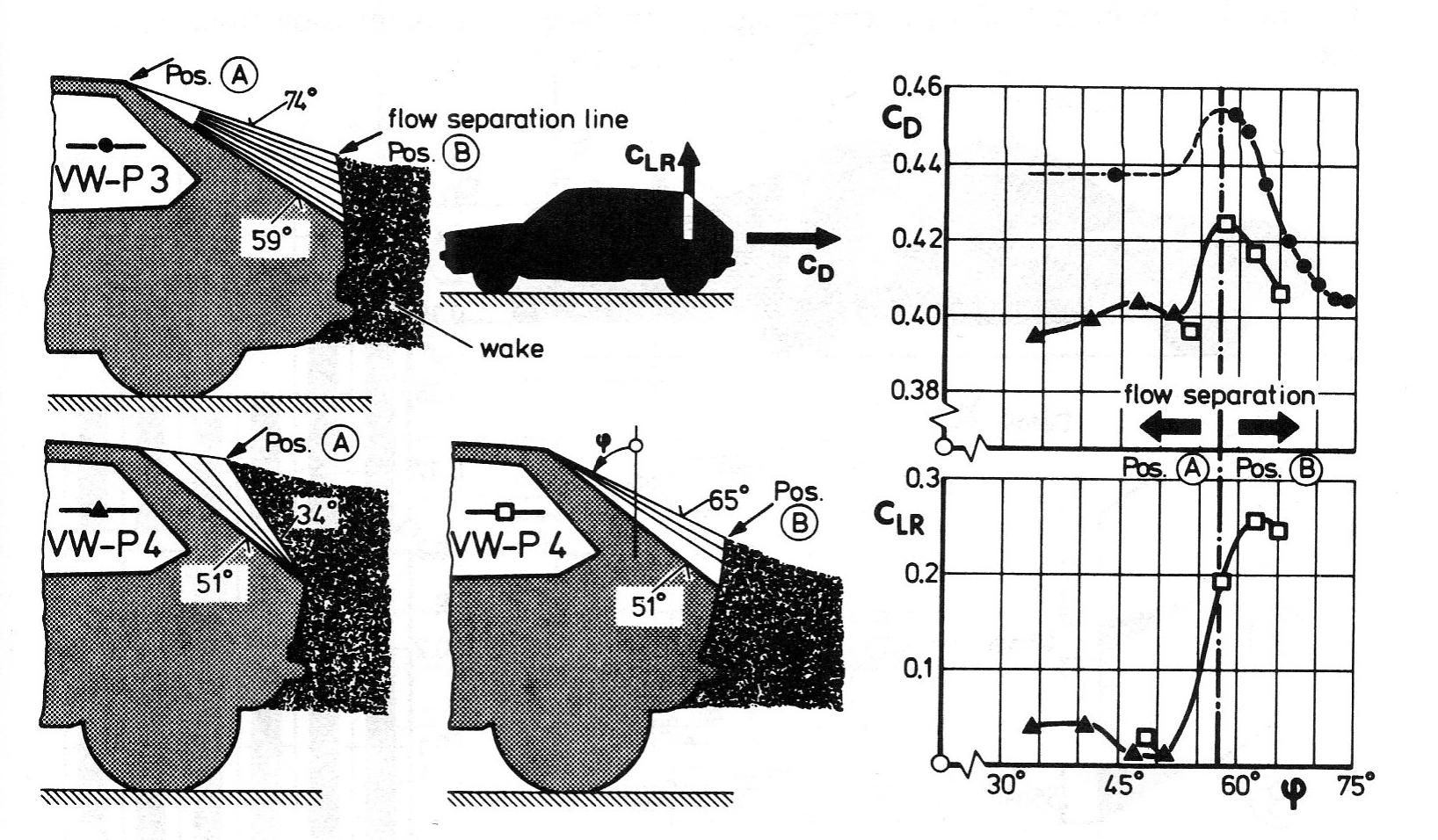
| CD | ||
| Open convertible | 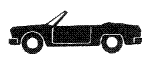 | 0.50 − 0.70 |
| Station wagon (2-box) | 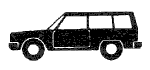 | 0.50 − 0.60 |
| Conventional form (3-box) | 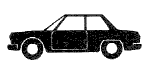 | 0.40 − 0.55 |
| Wedge shape, headlamps & bumpers integrated in body, wheels covered, undebody covered, optimized flow of cooling air | 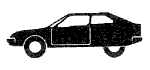 | 0.30 − 0.40 |
| Headlamps and all wheels enclosed within body, underbody covered | 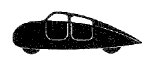 | 0.20 − 0.25 |
| K-shape (minimum cross section at tail) | 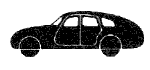 | 0.23 |
| Optimum streamlining | 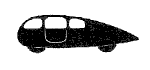 | 0.15 − 0.20 |
| Trucks, combinations | 0.80 − 1.50 | |
| Motorcycles | 0.60 − 0.70 | |
| Buses | 0.60 − 0.70 | |
| Streamlined buses | 0.30 − 0.40 | |
Motorcycle
Although, with a little imagination, practically any vehicle can be modeled with equation (5), for motorcycle it might be faster to use the following data:
| Shape | CD |
| Full fairing − driver laying low | 0.55 |
| Full fairing | 0.60 |
| Typical | 0.65 |
| No fairing − driver sitting straight | 0.70 |
Frontal area (more)
For passenger cars, the frontal area varies in the range of 79%-84% of the area calculated from the overall vehicle width and height. (82% is used in the calculator on this site)
For passenger cars with mass in the range of 800-2000 kg, the relationship between frontal area and the vehicle mass may be approximately expressed by:
|
(6) |
Where Af is the frontal area and m is the mass of the vehicle. The previous information comes from Theory of ground vehicles (2nd, p.175). This site uses equation (7) which gives basically the same values in the range 800-2000 kg (error: ±2%), but gives more logical values out of the range (for example with a mass of 0 kg you get an area of 0 m²).
|
(7) |