Tire friction and rolling resistance coefficients
Sources (more)
Sources
Rolling resistance coefficient (more)
Rolling resistance coefficients comes mainly from the following sources. Those not mentioned are educated guesses.
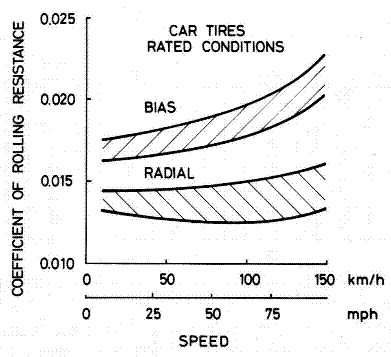
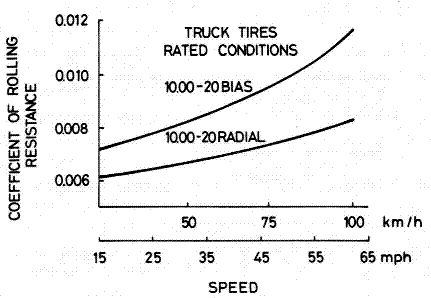
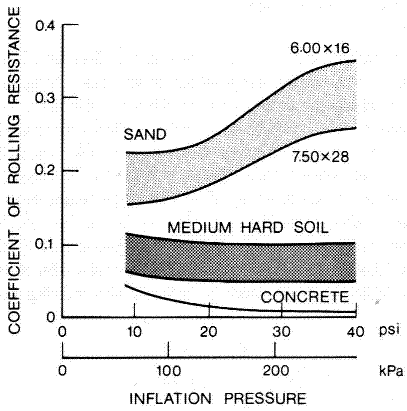
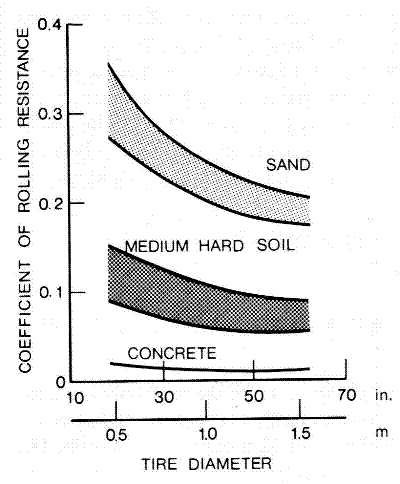
| Tire type | Concrete | Medium hard soil | Sand |
| Passenger car | 0.015 | 0.08 | 0.30 |
| Truck | 0.010 | 0.06 | 0.25 |
| Tractor | 0.020 | 0.04 | 0.20 |
| Road surface | Roll. resist. coeff. |
| Car tires − large sett pavement | 0.015 |
| Car tires − small sett pavement | 0.015 |
| Car tires − concrete, asphalt | 0.013 |
| Car tires − rolled gravel | 0.02 |
| Car tires − tarmacadam | 0.025 |
| Car tires − unpaved road | 0.05 |
| Car tires − field | 0.10 − 0.35 |
| Truck tires − concrete, asphalt | 0.006 − 0.010 |
| Strake wheels − field | 0.14 − 0.24 |
| Track-type tractor − field | 0.07 − 0.12 |
Based on Influence of Road Wetness on Tire-Pavement Rolling Resistance, the «dry asphalt» rolling resistance coefficients were increased by 20% to get the ones for wet conditions.
Friction coefficient (more)
The friction coefficient of a tire is based on the general theory of friction. The friction coefficient of a tire varies with the amount of skidding or spinning of the tire. «100% skidding» means the wheel is locked while the vehicle is moving (a situation similar to the tire moving sideways) and «100% slipping» means the wheel is rotating while the vehicle is not moving. Under these situations, there is a relative motion between the road and the tire, hence it is under kinetic friction (or sliding). Peak values for the friction coefficient of a tire happen around 20% skidding (or slipping) and may be related to static friction.
Friction coefficients comes mainly from the following sources. Those not mentioned are educated guesses, except for the drag tire friction coefficient. The enginnering department of a reputable tire manufacturer confirm that its value is 3.00 but it can go up to 5.00 when the slip is initiated because of a more complex compound that behaves more like glue than friction. The average value of 4.00 seems to give good approximation when evaluating performance. Note also the similarity between the peak and sliding values for «gravel» and «earth road (dry)». This is because the friction coefficient is the one from «gravel-to-gravel» contact since it is lower than the one from «tire-to-gravel» contact. The gravel is constantly sliding on itself.
| Road surface | Peak value | Sliding value |
| Asphalt and concrete (dry) | 0.80 − 0.90 | 0.75 |
| Asphalt (wet) | 0.50 − 0.70 | 0.45 − 0.60 |
| Concrete (wet) | 0.80 | 0.70 |
| Gravel | 0.60 | 0.55 |
| Earth road (dry) | 0.68 | 0.65 |
| Earth road (wet) | 0.55 | 0.40 − 0.50 |
| Snow (hard-packed) | 0.20 | 0.15 |
| Ice | 0.10 | 0.07 |
| Dry | Wet | |
| min | 0.715 | 0.513 |
| max | 0.850 | 0.825 |
| average | 0.756 | 0.641 |
| Vehicle speed (km/h) | Tread depth (mm) | Road condition | ||||
| Dry | Wet Water depth ≈ 0.2 mm | Heavy rainfall Water depth ≈ 1 mm | Puddles Water depth ≈ 2 mm | Ice (Black ice) | ||
| 50 | new | 0.85 | 0.65 | 0.55 | 0.50 | ≤ 0.10 |
| 50 | 1.6 | 1.00 | 0.50 | 0.40 | 0.25 | ≤ 0.10 |
| 90 | new | 0.80 | 0.60 | 0.30 | 0.05 | |
| 90 | 1.6 | 0.95 | 0.20 | 0.10 | 0.05 | |
| 130 | new | 0.75 | 0.55 | 0.20 | 0.00 | |
| 130 | 1.6 | 0.90 | 0.20 | 0.10 | 0.00 | |
| racing tires | up to 1.8 | |||||
Treadwear
Since the data presented above was gathered in the 1970's and 1980's and might not also represents today's high performance tire, to find a relationship between the treadwear and the friction coefficient, results from tests done by Tire Rack between 2002 and 2010 were studied. Here are the conclusions of this study:
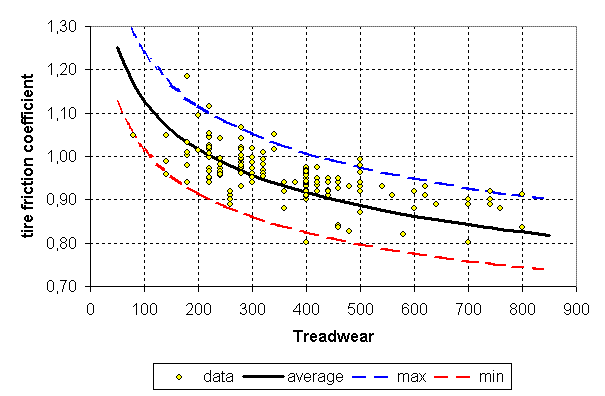
The average friction coefficient (µ) is related to the treadwear (TW) as presented in equation (1). Plots for the maximum and minimum values are simply ±10% of the average.
|
(1) |
Method
The method used to estimate the maximum friction coefficient from the test results were based on two results: average cornering force (g-force) and stopping distance (50-0 mph). Since other factors (suspension tuning, brake bias, ABS, etc.) may affect those results (always lowering the performance), the one that gave the highest friction coefficient was recorded.
It was assumed that the g-force was equal to the friction coefficient based on equation (2) where the friction force − the friction coefficient times the vehicle's weight (mg) − is assumed to be equal to the vehicle mass (m) times the lateral acceleration (a).
|
(2) |
As for the stopping distance (d), it was assumed it was related to the friction coefficient as in equation (3):
|
(3) |
Where g is the gravitational acceleration, v is the initial velocity when the brakes are applied and fr is the rolling resistance coefficient and was assume to be equal to 0.013. A common value for K, for production car, is 0.0000658 s2/m2; e is the Euler number and is equal to 2.718281828.
Expected mileage
The treadwear is a relative measure of the expected mileage of a tire. Since it is open to some interpretation from the manufacturers, it is not really reliable. Some state that, in ideal conditions, a life expectancy of 50 000 km for a tire with a treadwear of 100 can be obtained (1). That is pretty unrealistic, especially if spirited driving is involved. This site uses a more conservative relationship (and this would be an average value, not a maximum or minimum):
|
(4) |